

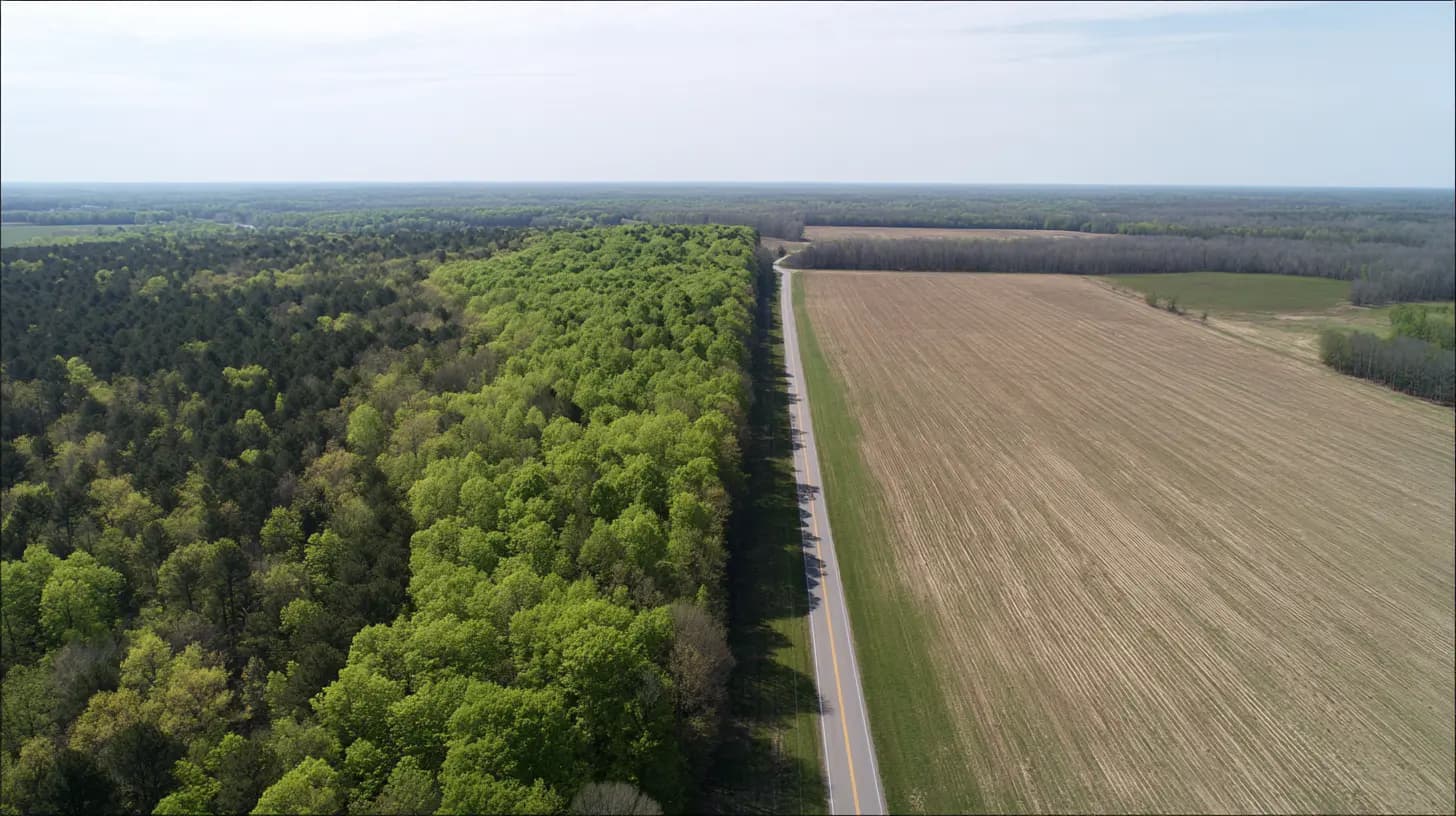
National Arbor Day fell on April 24 in 2026, the last Friday in April. It is a good day to plant a tree. It is also a good day to look at where the trees already are. Some states are overwhelmingly forested. Others barely register. And even then, the statewide percentage does not tell you much about the canopy people actually see outside their windows. Here is a data-first look at forest cover across all 50 states.
36.7%
U.S. forest share
of total land area
829M
Forest acres
across 50 states
2.4
Acres per person
national average
89.06%
#1 Maine
most forested state
What stands out
- The East and Upper South dominate. All ten of the most forested states are east of the Mississippi. Maine, New Hampshire, West Virginia, and Vermont each top 76%.
- Giant western states do not lead on percentage. Alaska has 134.9M forested acres, more raw acreage than any state east of the Rockies, but its enormous land base puts it at just 36.95%.
- Low density and high forest often travel together. Maine has 45.9 people per square mile and 89% forest. North Dakota has 11.6 people per square mile and under 2% forest. But some dense, urban states break the pattern.
- Forest land and urban tree canopy are different things. A state can be 60% forested and still have treeless suburbs. Forest cover is a land classification with acreage and density thresholds. Canopy is a continuous measurement of what is actually overhead.
Forest share by state
Percentage of total land area classified as forest. Nationally, about 36.7% of U.S. land qualifies.
The 10 most forested states
Maine stands alone at 89.06%. Nearly nine out of every ten acres in the state are forest. New Hampshire and West Virginia follow, both above 78%. The entire top ten sits east of the Mississippi, a legacy of climate, topography, and lower-intensity land use compared to the Great Plains and arid West.
Forest share
The 10 most forested states
Share of each state's land area classified as forest.
| Label | Secondary label | Forest share |
|---|---|---|
| Maine | 17.6M acres | 89.1% |
| New Hampshire | 4.8M acres | 83% |
| West Virginia | 12.0M acres | 78.1% |
| Vermont | 4.5M acres | 76.5% |
| Alabama | 23.1M acres | 71.4% |
| South Carolina | 12.9M acres | 67.2% |
| Georgia | 24.6M acres | 66.9% |
| Mississippi | 19.4M acres | 64.5% |
| Virginia | 16.0M acres | 63.5% |
| New York | 18.9M acres | 62.6% |
Note: Forest share is forest land as a percentage of total land area. Acreage labels are derived from each state's land area and forest share.
Source: USDA Forest Service FIA program 2022 assessment; U.S. Census Bureau MAF/TIGER land area.
The 10 least forested states
North Dakota brings up the rear at 1.82%. The bottom five are all Great Plains states where grassland and cropland dominate the landscape. Nebraska, South Dakota, and Kansas each sit below 5%. Further up the list, Illinois and Nevada are the least forested states in their respective regions, for entirely different reasons - one is farmed flat, the other is high desert.
| Rank | State | Forest share | Forest acres | People/sq mi |
|---|---|---|---|---|
| #50 | North Dakota | 1.82% | 804K | 11.6 |
| #49 | Nebraska | 3.12% | 1.5M | 26.3 |
| #48 | South Dakota | 4.02% | 2.0M | 12.3 |
| #47 | Kansas | 4.83% | 2.5M | 36.4 |
| #46 | Iowa | 8.18% | 2.9M | 58 |
| #45 | Illinois | 14.02% | 5.0M | 229.1 |
| #44 | Nevada | 15.04% | 10.6M | 29.9 |
| #43 | Wyoming | 16.89% | 10.5M | 6.1 |
| #42 | Indiana | 21.27% | 4.9M | 194.6 |
| #41 | Arizona | 25.61% | 18.6M | 67.1 |
Tree-rich, crowded, and somewhere in between
Ranking states by forest share alone misses something. A state can be heavily forested and nearly empty, or densely populated with a surprising amount of tree cover. Plotting forest share against population density shows the real variety.
High forest, low density is the classic woodland state. Maine (89.06% forest, 45.9 people/sq mi) and West Virginia (78.05%, 73.5/sq mi) sit in this corner. So does Vermont and Montana.
High forest, high density is more surprising. Connecticut (58.34% forest, 761.8 people/sq mi) and New Jersey (42.28%, 1298.4/sq mi) are among the most densely populated states in the country and still manage 40-58% forest cover. Massachusetts is similar. These are small states where development concentrates tightly, leaving large tracts of second-growth forest between the highways and subdivisions.
Low forest, high density is expected. Illinois (14.02% forest) is farmed and urbanized. But some large, low-density states also have very little forest. Low forest, low density is the Plains story. North Dakota, Kansas, and Nebraska are sparsely populated, but the land is grassland and agriculture, not timber.
And then there are the raw-acreage giants. Texas has 63.1M forested acres, more than most eastern states, but that is only 37.76% of a state so large it contains three climate zones. Alaska is similar: massive absolute acreage, modest percentage.
Forest share and population density split states into different stories
Each point is a state below 500 people per square mile, plotting forest share against population density.
- Median density: x-axis reference at 109 /sq mi
- Median forest share: y-axis reference at 41.5 %
| state | Population density | Forest share |
|---|---|---|
| ME | 45.9 /sq mi | 89.1 % |
| NH | 158 /sq mi | 83 % |
| WV | 73.5 /sq mi | 78.1 % |
| VT | 69.9 /sq mi | 76.5 % |
| AL | 103 /sq mi | 71.4 % |
| SC | 185 /sq mi | 67.2 % |
| GA | 197 /sq mi | 66.9 % |
| MS | 63 /sq mi | 64.5 % |
| VA | 225 /sq mi | 63.5 % |
| NY | 424 /sq mi | 62.6 % |
| NC | 230 /sq mi | 60.5 % |
| PA | 292 /sq mi | 59 % |
| AR | 59.9 /sq mi | 57.2 % |
| MI | 179 /sq mi | 56.1 % |
| LA | 107 /sq mi | 54.2 % |
| TN | 177 /sq mi | 52.9 % |
| WA | 120 /sq mi | 52.5 % |
| FL | 438 /sq mi | 50.1 % |
| WI | 110 /sq mi | 49.3 % |
| KY | 117 /sq mi | 49.2 % |
| OR | 44.5 /sq mi | 48.4 % |
| ID | 24.6 /sq mi | 40.8 % |
| TX | 121 /sq mi | 37.8 % |
| AK | 1.3 /sq mi | 37 % |
| CA | 253 /sq mi | 36.9 % |
| HI | 223 /sq mi | 35.8 % |
| MO | 91.2 /sq mi | 35 % |
| UT | 43.1 /sq mi | 34.8 % |
| CO | 58 /sq mi | 34.4 % |
| MN | 73.2 /sq mi | 34.2 % |
| NM | 17.5 /sq mi | 31.7 % |
| OH | 291 /sq mi | 30.9 % |
| OK | 60.1 /sq mi | 28 % |
| MT | 7.9 /sq mi | 27.8 % |
| AZ | 67.1 /sq mi | 25.6 % |
| IN | 195 /sq mi | 21.3 % |
| WY | 6.1 /sq mi | 16.9 % |
| NV | 29.9 /sq mi | 15 % |
| IL | 229 /sq mi | 14 % |
| IA | 58 /sq mi | 8.18 % |
| KS | 36.4 /sq mi | 4.83 % |
| SD | 12.3 /sq mi | 4.02 % |
| NE | 26.3 /sq mi | 3.12 % |
| ND | 11.6 /sq mi | 1.82 % |
Note: Dashed lines mark median forest share (41.5%) and median density (108.6/sq mi). States above 500 people/sq mi omitted for readability: MA (917.2), CT (761.8), RI (1077.9), NJ (1298.4), MD (645.4), DE (543.8).
Source: USDA Forest Service FIA program 2022 assessment; U.S. Census Bureau Vintage 2025 estimates and MAF/TIGER land area.
One more way to picture it
If you shrank each state down to a 100-square-mile tile, Maine's tile would be 89square miles of forest. North Dakota's would be less than 2.
The national average works out to roughly 2.4 forested acres per American. But that number varies wildly. In Alaska, each resident's theoretical share is 183.03 acres. In New Jersey, it is 0.21 acres.
None of this means you personally own any of those acres, of course. But Arbor Day is a good excuse to notice the difference between green on a map and shade on your block. The states with the most forest on paper are not always the ones where residents experience the most trees. And the states with the least forest are sometimes doing more with street trees, parks, and urban canopy than their statewide numbers would suggest.
Go outside. Look up. Happy Arbor Day.